

Frontier Supercomputer Creates Detailed Simulation of the Early Universe
The Lumina simulation showed how the first galaxies and black holes altered intergalactic gas
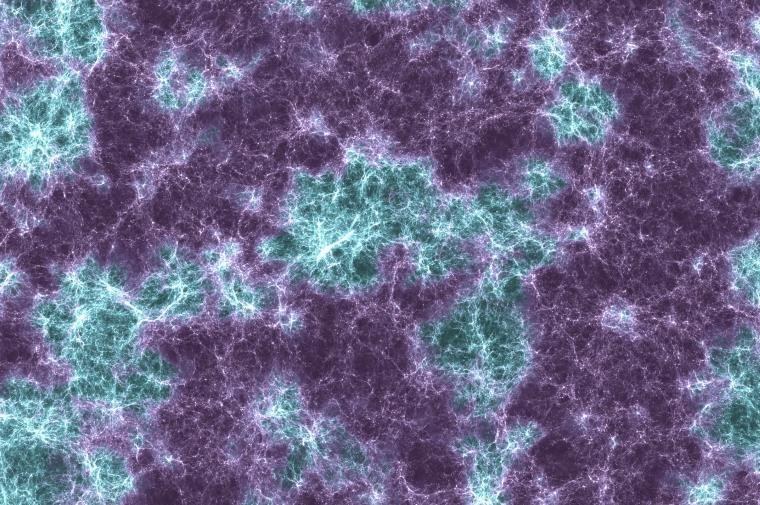
An international team of researchers presented Lumina, a large-scale computer simulation of the early Universe. The calculations were performed on the Frontier supercomputer at the US Oak Ridge National Laboratory.
The model covers a region 500 megaparsecs across — about 1.6 billion light-years at current scales. According to project participants, its volume is approximately 100 times greater than that of the best previous comparable simulations. At the same time, its level of detail makes it possible to study individual forming galaxies.
Lumina begins its timeline approximately 45 million years after the Big Bang and traces the development of the cosmos over the first 2 billion years. It accounts for the interactions of gas, dark matter, stars and radiation.

The researchers paid particular attention to reionization — the processes in which radiation strips electrons from atoms of intergalactic gas. In the case of hydrogen, the primary sources of this radiation were early stars and galaxies. The subsequent reionization of helium was associated primarily with the more energetic radiation of active supermassive black holes.
By tracking both processes in a single model, scientists can investigate how the temperature and state of the gas changed and how these changes affected the subsequent evolution of cosmic structures.
The calculations used 1884 Frontier nodes — more than 105 thousand processor cores and 7536 AMD accelerators. The simulation includes 432 billion computational elements.
Lumina will help compare theoretical predictions with telescope observations and study the connection between the first galaxies and their surrounding environment. The results of the work were published in Monthly Notices of the Royal Astronomical Society.