
Scientists altered the environment of aluminum atoms to extend the lifespan of sodium-sulfur batteries
A new catalyst helps suppress one of the capacity loss mechanisms. Laboratory cells passed tests over 2,500 charge and discharge cycles
Researchers from the Chinese Academy of Sciences and Anhui University have developed an aluminum catalyst for sodium-sulfur batteries. The results were published in the journal Angewandte Chemie International Edition.
Sodium and sulfur are abundant materials, making such batteries a promising option for low-cost energy storage. However, their durability is limited by the transfer of soluble sodium polysulfides between electrodes. This "shuttle effect" leads to the loss of active material and degradation of performance.
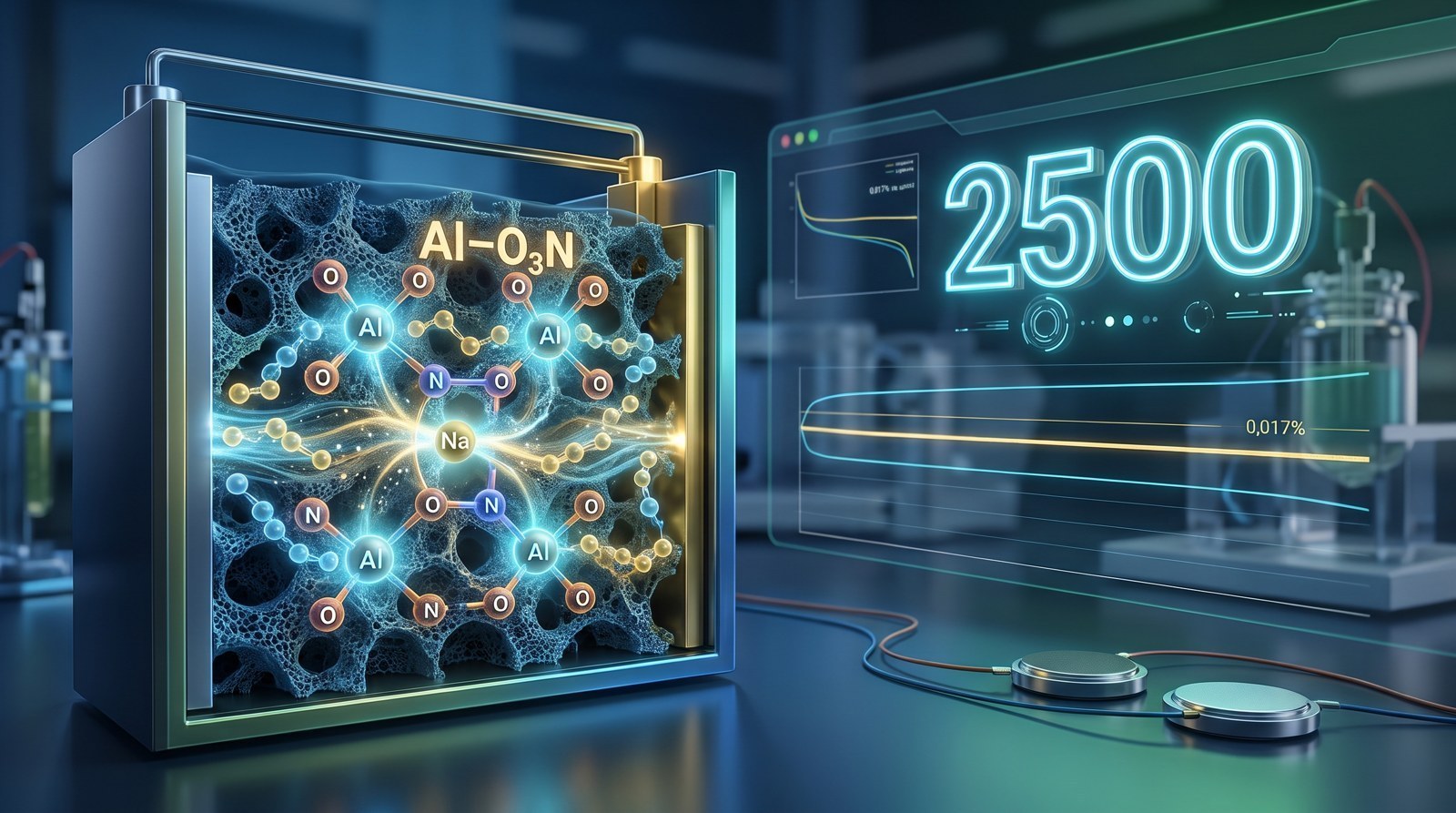
Scientists altered the environment of individual aluminum atoms anchored on a carbon material. In a structure where aluminum is bonded to four oxygen atoms, one of them was replaced with nitrogen, resulting in an Al–O₃N configuration.

This restructuring changes the electron distribution and enhances interaction with sodium polysulfides. The catalyst helps retain these compounds and accelerates reactions involving sulfur.
In tests, the material demonstrated a specific capacity of 1,196 mAh/g after 100 cycles at a 0.1 C rate. In a separate long-term test of 2,500 cycles, the authors reported an average capacity loss of 0.017% per cycle.
These figures pertain to laboratory electrochemical material and test cells. The value of 1,196 mAh/g cannot be applied to the mass of a finished battery as a whole, including the casing and other components. Additionally, losses accumulate with each cycle: this does not mean a total reduction of only 0.017% over the entire test.
The work demonstrates how to improve the efficiency of a catalyst made from an accessible metal by altering its atomic structure. The feasibility of mass production and the characteristics of full-scale batteries remain to be verified.