
Free curvature signal for flow matching samplers estimates error
A study on the Anima model showed that the angle between adjacent velocities effectively estimates step error, but an adaptive controller underperforms compared to a standard schedule.
In flow matching, an image is constructed through sequential integration of a differential equation, with each step requiring the execution of a large neural network. The study examined whether the angle between the current and previous velocities could be used to select the step size without additional model calls.
This signal reflects the trajectory's turning but not changes in the velocity vector's length. For most of the Anima trajectory, this was sufficient: the angle-based estimate closely matched the actual local Euler step error. At the trajectory's ends, the contribution of length changes increased significantly, making the cosine alone insufficient.
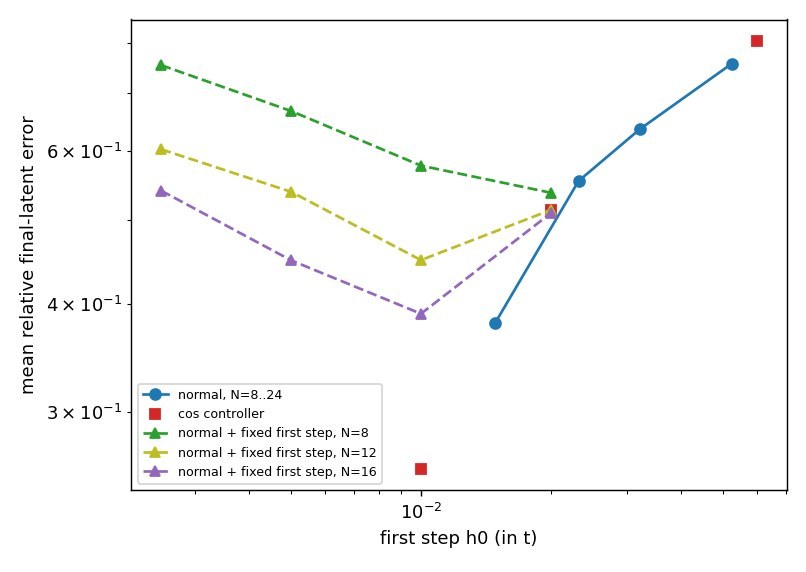
An adaptive controller that increased or decreased the next step based on the measured angle performed worse than the standard schedule. The primary reason was the first step: the controller lacked history, even though curvature was maximal at the start. Reducing the initial step improved results but did not eliminate the issue.

A static grid performed better. It was pre-constructed based on the average rate of velocity turns in other test images, ensuring denser steps in areas with stronger curvature. With the same number of network calls, the error relative to the converged solution was 30–43% lower, and accounting for the error propagation profile, the advantage reached 41–50%.
However, the result depends on the metric. According to LPIPS, this grid was typically better for images with faces, flat fills, and geometric patterns but underperformed by approximately 16% on textured prompts, even though the distance in latent space improved. The findings are limited to one Anima model, a single resolution, guidance scale, and test sample; the author also notes the sensitivity of results to bf16 computation implementation.