

When an AI Agent Is More Than Just a Smart Prompt
An AI agent in an organization is not just a large language model with API access, but a distributed system with a decision loop, limited tools, external memory, and security policies.
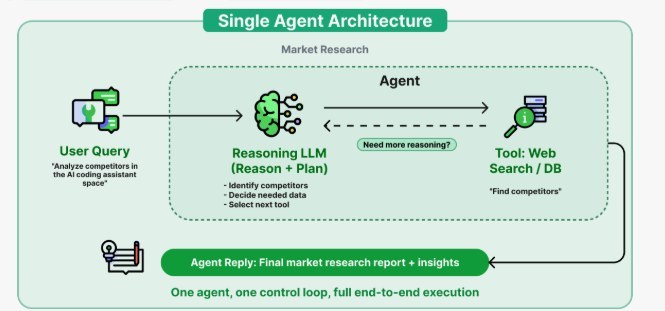
For fixed processes, deterministic pipelines are suitable: the model extracts data or classifies a request at specific points, while the remaining steps are defined by code. A single agent is convenient with a small number of branches, but on a long chain, it may overflow the context and lose the original goal.
Complex tasks can be divided among agents: an analyst gathers data, a validator checks it, and a formatter prepares the document. Structured artifacts, rather than raw dialogues, are needed between stages. Parallel branches reduce latency but require rules for partial failure scenarios. The Orchestrator-Worker dynamically builds a plan for unpredictable processes, though it consumes more tokens. If 80% of tasks fit into a fixed scenario, this pattern is unnecessary.
Payments, the sending of legally significant documents, and data deletion should be paused until confirmed by a human. The system must preserve its state, record the approver of an action, and be able to resume work. To guard against errors, structured tool responses, validators, a confidence threshold (e.g., 0.8), and an iteration limit of 2–3 cycles are used. The state after each step can be saved in an external database to resume the process from a checkpoint after a failure.