
Google expands TPU lineup for confidential computing and long contexts
The TPU 8tx system protects data and model parameters during processing. In TPU 8i Max, Google combined two chips in a single module and doubled the HBM memory bandwidth compared to TPU 8i.
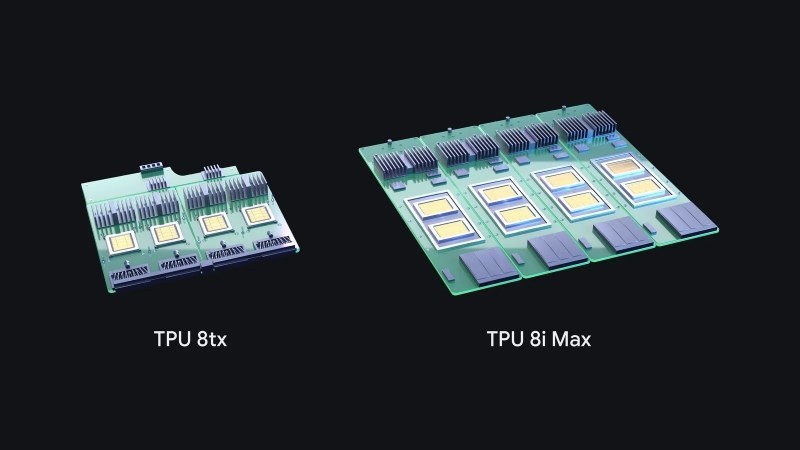
On November 9, Google introduced TPU 8tx and TPU 8i Max—two systems based on eighth-generation tensor processing units. They complement the TPU 8t for training large models and TPU 8i for low-latency model inference, announced in April.
TPU 8tx uses the same chips as TPU 8t, paired with fifth-generation AMD EPYC server processors. According to Google, hardware-based protection isolates sensitive data and model weights even during computations. A single cluster can be used to train and fine-tune models on confidential data, transfer knowledge from large models to more compact ones, and train reinforcement-learning AI agents.
For data exchange, TPU 8tx employs the Boardfly network. Google states that it reduces latency by up to two times compared to TPU 8t, with minimal impact on performance from hardware protection.

TPU 8i Max combines two TPU 8i chips in a single module. Compared to TPU 8i, the new configuration doubles computational resources, on-chip SRAM memory capacity, and HBM bandwidth. Google designed it for tasks where models must simultaneously process large volumes of information, such as an entire codebase or several hours of video. Doubling the number of chips within the same rack dimensions allows for more computational resources in the same footprint.
Google also introduced a preview version of TPU Agent. The toolkit integrates with Claude Code, Cursor, and Google Antigravity, helping configure accelerator workflows, identify bottlenecks, and optimize compute kernels. For model deployment, the company offers the open-source XLA Serving Engine, which enables running models in a C++ environment on TPU, GPU, and CPU.